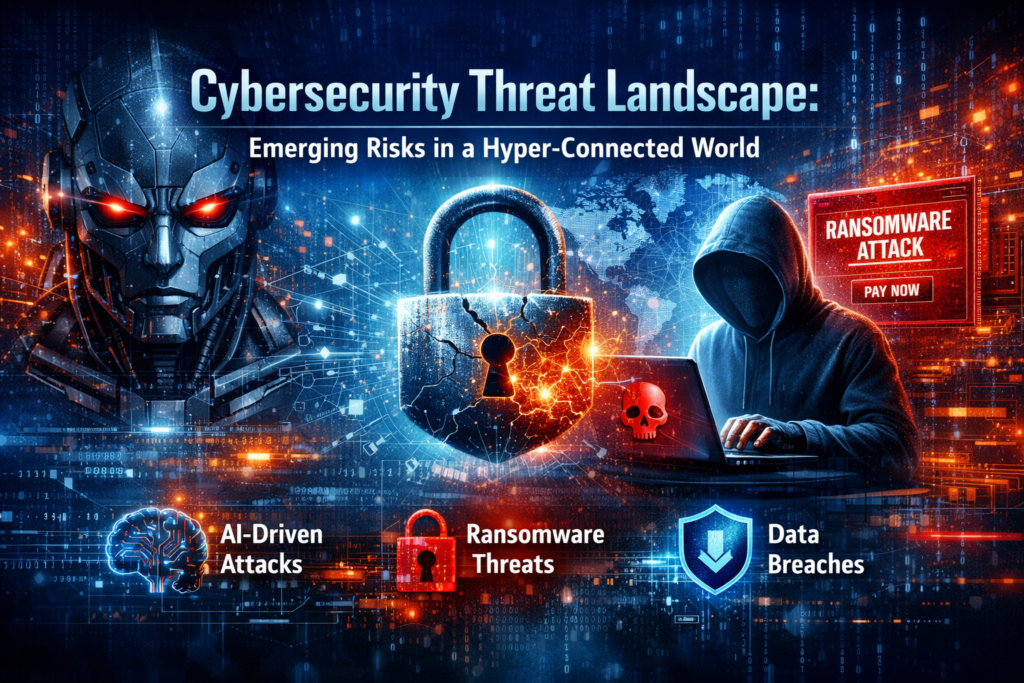
Introduction
We live in an era where digital connectedness drives nearly every aspect of personal and professional life. From online banking and healthcare records to smart homes and remote work technologies, digital systems are now woven into the fabric of modern society. This hyper-connected world brings unparalleled convenience, productivity, and efficiency — but it also dramatically expands the attack surface for cybercriminals.
Cybersecurity, once a niche concern for IT teams, is now a strategic priority for businesses, governments, and individuals worldwide. The threat landscape is no longer static; it evolves continuously, influenced by technological innovation, geopolitical conflict, economic motivations, and human behavior. This overview explores the emerging risks shaping today’s cybersecurity environment, highlights the major threat categories, and offers insight into how organizations and individuals can adapt and defend against them.
Why Cybersecurity Matters More Than Ever
In recent years, cyber threats have increased in volume, scope, and sophistication. According to industry studies, a majority of business leaders now believe cybersecurity risks are rising — and not just incrementally but at an accelerating pace. In a 2025 cybersecurity outlook, 68% of business leaders reported heightened risks related to cyber threats, with the average data breach cost rising to over $4.4 million.
The impact of a cyberattack can be devastating:
Financial loss due to theft or operational shutdown
Loss of intellectual property
Damage to brand reputation
Regulatory penalties
Erosion of customer trust
Whether it’s a ransomware attack on critical infrastructure or a single phishing email compromising an employee’s credentials, every cybersecurity incident underscores how interconnected and vulnerable systems truly are.
Defining the Cybersecurity Threat Landscape
The term “cybersecurity threat landscape” refers to the evolving set of risks, vulnerabilities, and attack vectors that individuals and organizations face in cyberspace. This landscape is shaped by multiple forces:
Technological advancements like artificial intelligence (AI) and the Internet of Things (IoT)
Global digitization and remote work practices
Increased adoption of cloud services
Geopolitical tensions and cyber warfare
Economic incentives of cybercriminals
As more digital technologies become essential to daily life, attackers continually seek new ways to exploit systems, software, and human behavior. Let’s analyze the most significant threats shaping the current cybersecurity environment.
- Ransomware and Ransomware-as-a-Service
Ransomware remains one of the most pervasive cyber threats. Traditionally, ransomware involved cybercriminals encrypting an organization’s data and demanding payment for decryption. Today, ransomware has evolved into a commoditized service known as Ransomware-as-a-Service (RaaS), where cybercrime groups sell ready-to-use ransomware toolkits to other attackers in exchange for a fee or revenue share.
RaaS has lowered the barrier to entry for cybercriminals, enabling even those with minimal technical expertise to launch high-impact attacks. Cybersecurity researchers observed that ransomware operations now function almost like legitimate SaaS businesses — complete with customer support and pricing tiers. - AI-Powered Attacks
Artificial Intelligence is revolutionizing both cyber defenses and offensive capabilities. While AI can enhance threat detection and response, it also empowers attackers to launch automated, highly effective attacks.
AI-Generated Phishing and Social Engineering
Cybercriminals are now using generative AI to craft highly convincing phishing emails, text messages, and social engineering campaigns that are personalized and difficult to detect. These AI-driven campaigns use public data, behavior analysis, and natural language generation to simulate credible communication, significantly increasing the likelihood of victims engaging with malicious content.
Deepfake-Based Attacks
With advancements in AI, attackers can produce “deepfake” audio, video, or images that convincingly impersonate executives, family members, or trusted contacts. These can be used to extract sensitive information or authorize harmful actions — such as fraudulent wire transfers — by manipulating human trust.
Adversarial AI and Model Manipulation - Cloud Vulnerabilities and Misconfigurations.
Cloud computing is now essential for businesses seeking agility and scalability. However, cloud platforms also introduce new security challenges. Misconfigured cloud environments have emerged as one of the most common causes of data breaches.
Example issues include:
Unsecured storage buckets
Inadequate access control policies
Weak identity and access management (IAM)
Lack of encryption for sensitive data
Cloud misconfigurations are often difficult to detect without robust monitoring and security auditing tools — making them attractive targets for attackers looking for easy gains.
Best Practices for Cloud Security
Strong IAM and least-privilege policies
Encryption of data at rest and in transit
Continuous configuration assessment
Use of cloud security posture management (CSPM) tools - IoT and Edge Device Exploitation.
The proliferation of Internet of Things (IoT) devices — from smart appliances to industrial control systems — vastly expands the attack surface. Each connected device is a potential entry point for attackers.
IoT devices often suffer from weak security defaults, lack of regular updates, and inconsistent vendor practices. Once compromised, these devices can be used as pivots into larger networks or for launching large-scale distributed denial-of-service (DDoS) attacks.
How to Reduce IoT Risks.
Network segmentation to isolate IoT devices
Enforcing strong authentication and firmware updates
Blocking unused services and ports - Supply Chain Attacks.
Cyberattackers are increasingly targeting third-party software vendors and service providers, knowing that compromising a widely used component can impact hundreds or thousands of downstream organizations. These “supply chain attacks” inject malicious code or components into trusted software repositories, exploiting trust and dependency relationships.
A notable example in recent years involved malicious packages uploaded to popular programming repositories that appeared legitimate but contained hidden malware.
Mitigation Strategies
Vet third-party security practices
Monitor dependencies for unauthorized changes
Use software composition analysis (SCA) tools - Highly Evasive Adaptive Threats.
Modern attackers use advanced methods to bypass traditional defenses such as secure web gateways or anti-malware software. Highly Evasive Adaptive Threats (HEAT) employ adaptive tactics — including malicious URLs hidden as trusted links — to slip past legacy detection systems.
Such threats illustrate that perimeter-based security is no longer sufficient. Organizations must adopt behavior-based detection, zero-trust access policies, and continuous monitoring to identify anomalous activity. - The Human Element: Social Engineering and Insider Risks.
Despite technological advances, human factors remain one of the most significant cybersecurity vulnerabilities. Attackers use social engineering to deceive individuals into revealing credentials, installing malware, or bypassing security controls. Sophisticated phishing and pretexting campaigns exploit trust and authority to trick victims into harmful actions.
Reducing Human-Centric Risks
Regular security awareness training
Simulated phishing exercises
Enforcement of strong authentication protocols - Geopolitical Tensions and Nation-State Threats.
Cybersecurity is no longer confined to criminal activity; state-sponsored cyber operations are increasingly common. Ongoing geopolitical tensions drive cyber espionage, data theft, and attacks on critical infrastructure. Nearly 60% of organizations report adjusting their security strategies due to geopolitical considerations.
These threats are often well-funded, sophisticated, and persistent, making detection and mitigation exceptionally challenging for defenders. - The Growing Cyber Inequity Gap.
A critical challenge in the cybersecurity landscape is the widening gap between large enterprises and smaller organizations. While top firms invest heavily in defense, a significant percentage of small entities lack basic cybersecurity resilience. This disparity creates weak links that attackers exploit to gain access to larger systems through interconnected networks. - Regulatory Pressures and Compliance Challenges.
Rapidly evolving regulations — such as data protection laws and cybersecurity mandates — add another layer of complexity. Compliance is not optional; violations can result in hefty fines, legal challenges, and public scrutiny. Organizations must align their cybersecurity strategy with global, regional, and industry standards while ensuring they remain agile and responsive.
Strategies for Navigating the Threat Landscape
Given the complexity and diversity of cyber threats, defenders must adopt a holistic approach:
- Zero Trust Architecture
Adopting zero trust principles — “never trust, always verify” — helps eliminate blind trust and enforce continuous authentication. - Continuous Monitoring and Exposure Management.
Real-time monitoring and automated exposure management platforms help organizations detect vulnerabilities as they emerge and prioritize remediation. - Cybersecurity Awareness Training
A well-informed workforce is one of the strongest lines of defense. Regular education on phishing, social engineering, and reporting procedures enhances overall security posture. - Incident Response Planning
A robust incident response plan minimizes damage during a breach and accelerates recovery. It includes clear roles, communication protocols, and remediation steps. - Collaboration and Information Sharing
Cyber threats are global and interconnected. Collaboration among industry peers, government agencies, and international partners strengthens collective defense.
Conclusion
The cybersecurity threat landscape is dynamic, complex, and continuously expanding. As digital technologies evolve, so do the risks associated with them. From ransomware and AI-powered attacks to supply chain vulnerabilities and geopolitical tensions, defenders must stay vigilant and adaptive.
Cybersecurity is no longer just a technical concern. It is a strategic imperative that affects every organization and individual who uses digital systems. By understanding emerging risks, adopting robust defenses, and fostering a culture of awareness, we can build a safer, more resilient digital world.